Understanding Closures in Set Theory
To understand closure, we need to understand the composition of relations.
Composition of Relations
Let $R$ and $S$ be two relations where
$R$ = {$(a, 0), (b, 1), (c, 2)$} and
$S$ = {$(0, x), (1, y), (2, z)$}
The composition of $R$ and $S$ is defined as $R \circ S$ = {$(a, x), (b, y), (c, z)$}.
Let’s understand this with diagrams. 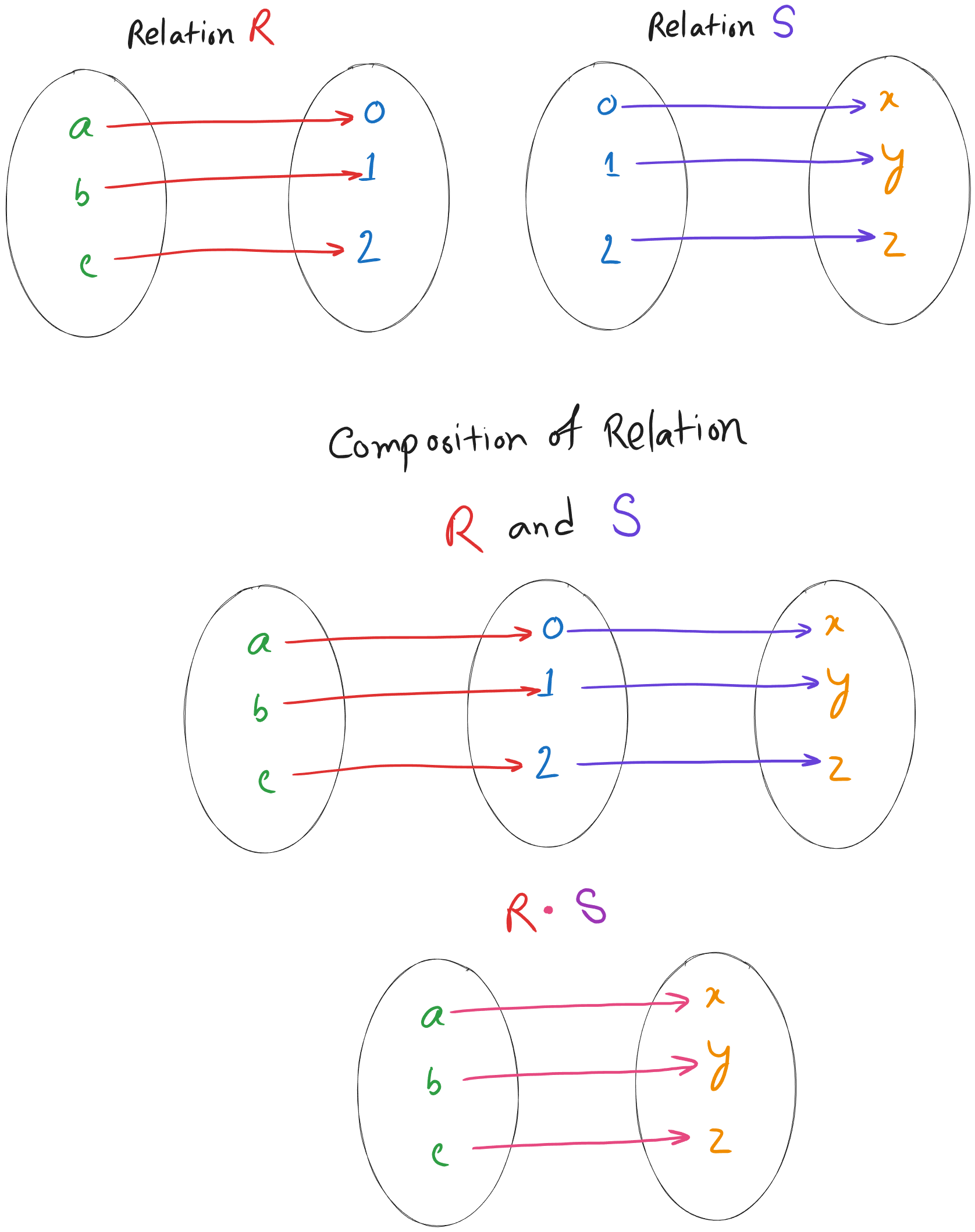
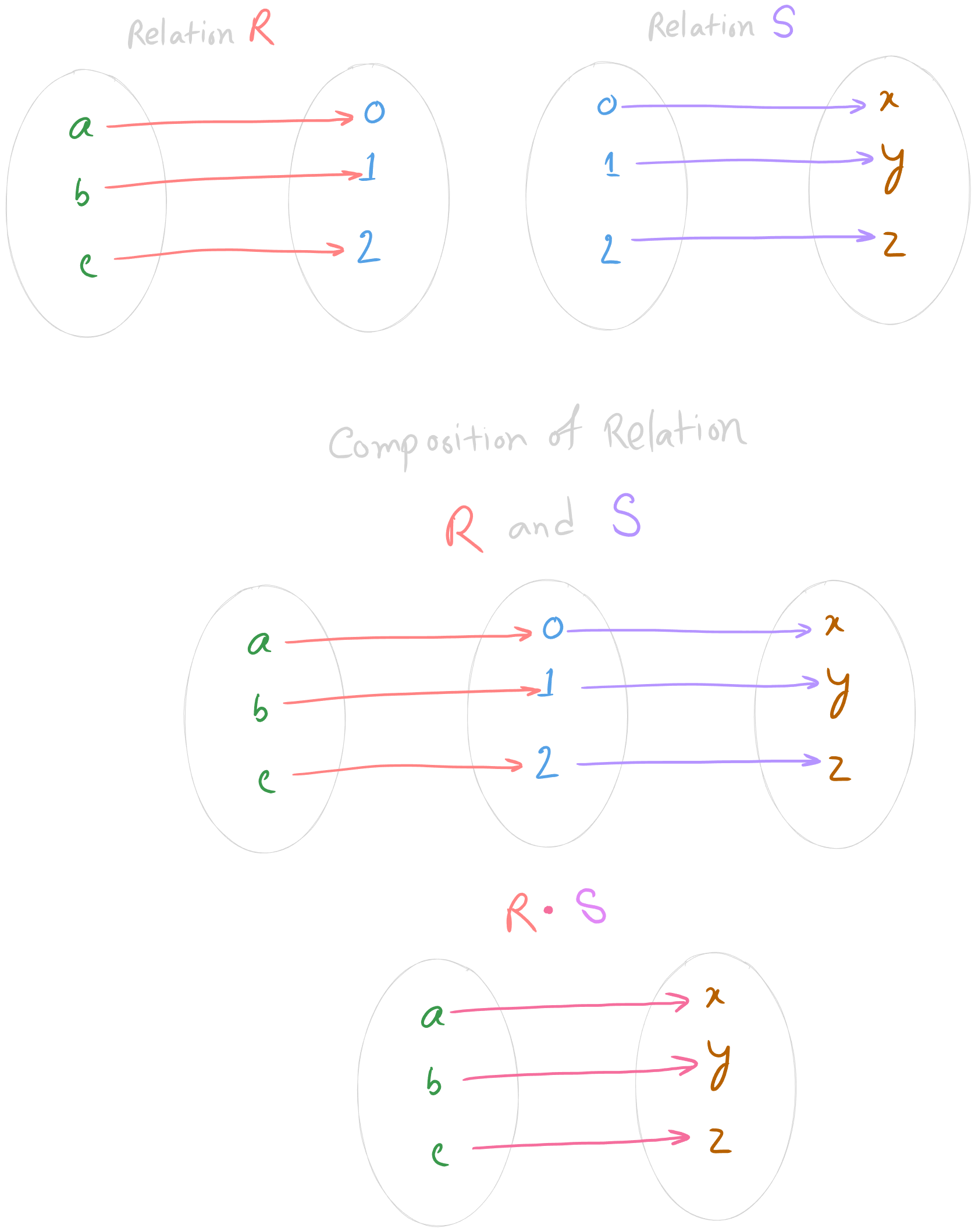
The composition is also called the product of relations. It’s ironically similar to matrix multiplication if you think about the elements of the relations as matrices.
Composition of Relations as Matrices
Lets take another example to understand the composition of relations by representing them as matrices.
Relation $R$ = {$(a, 0), (b, 1), (c, 2)$} can be represented as a matrix
\[\begin{array}{c c} & \begin{array}{c c c} 0 & 1 &2 \\ \end{array} \\ \begin{array}{c c c}a\\b\\c \end{array} & \left[ \begin{array}{c c c} 1 & 0 & 0 \\ 0 & 1 & 0 \\ 0 & 0 & 1 \end{array} \right] \end{array}\]Relation $S$ = {$(0, x), (1, y), (2, z)$} can be represented as a matrix
\[\begin{array}{c c} & \begin{array}{c c c} x & y &z \\ \end{array} \\ \begin{array}{c c c}0\\1\\2 \end{array} & \left[ \begin{array}{c c c} 1 & 0 & 0 \\ 0 & 1 & 0 \\ 0 & 0 & 1 \end{array} \right] \end{array}\]And the composition of $R$ and $S$ is basically the matrix multiplication of $R$ and $S$.
\[\left[ \begin{matrix} 1 & 0 & 0 \\ 0 & 1 & 0 \\ 0 & 0 & 1 \end{matrix} \right] \cdot \left[ \begin{matrix} 1 & 0 & 0 \\ 0 & 1 & 0 \\ 0 & 0 & 1 \end{matrix} \right] = \left[ \begin{matrix} 1 & 0 & 0 \\ 0 & 1 & 0 \\ 0 & 0 & 1 \end{matrix} \right]\]Now you can see why the composition of relations is also called the product of relations or written as $R \circ S$.
Closure of Relations
There are three types of closures of relations.
- Reflexive Closure
- Symmetric Closure
- Transitive Closure
We will particularly focus on the transitive closure of relations.
Transitive Closure
Let’s try to understand this by using a simple logic. Say, $R$ = {$(a, b), (b, c), (c, d)$}.
where, $R(x, y)$ means $x > y$.
Simply by looking at the relation we can say that $a > b$, $b > c$, and $c > d$.
Now we can also infer that
- $a > c$ because $a > b$ and $b > c$.
- $b > d$ because $b > c$ and $c > d$.
How can we induce and represent this in terms of relation composition?
If we try to compose the relation $R$ with itself, i.e. $R \circ R$, then, 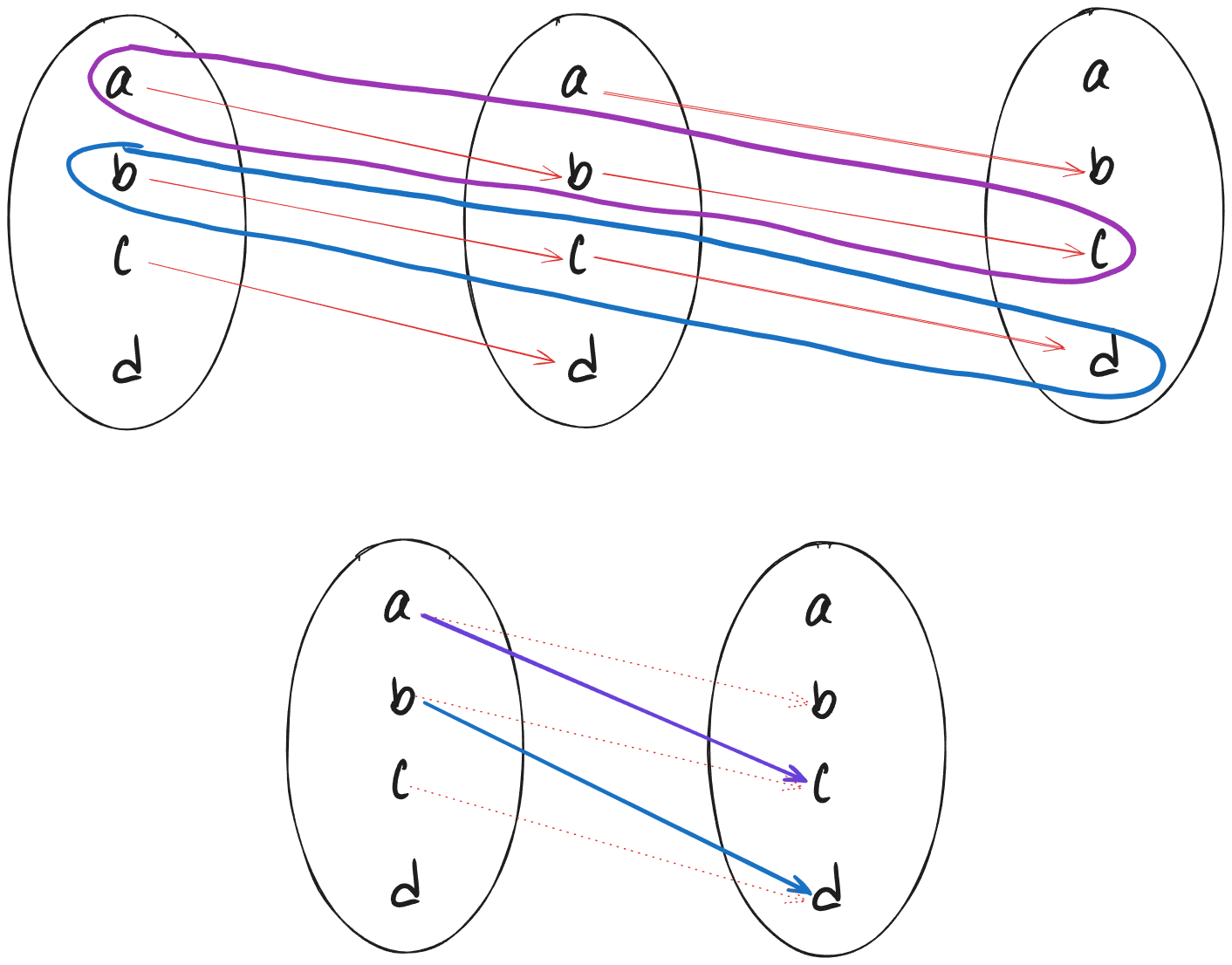
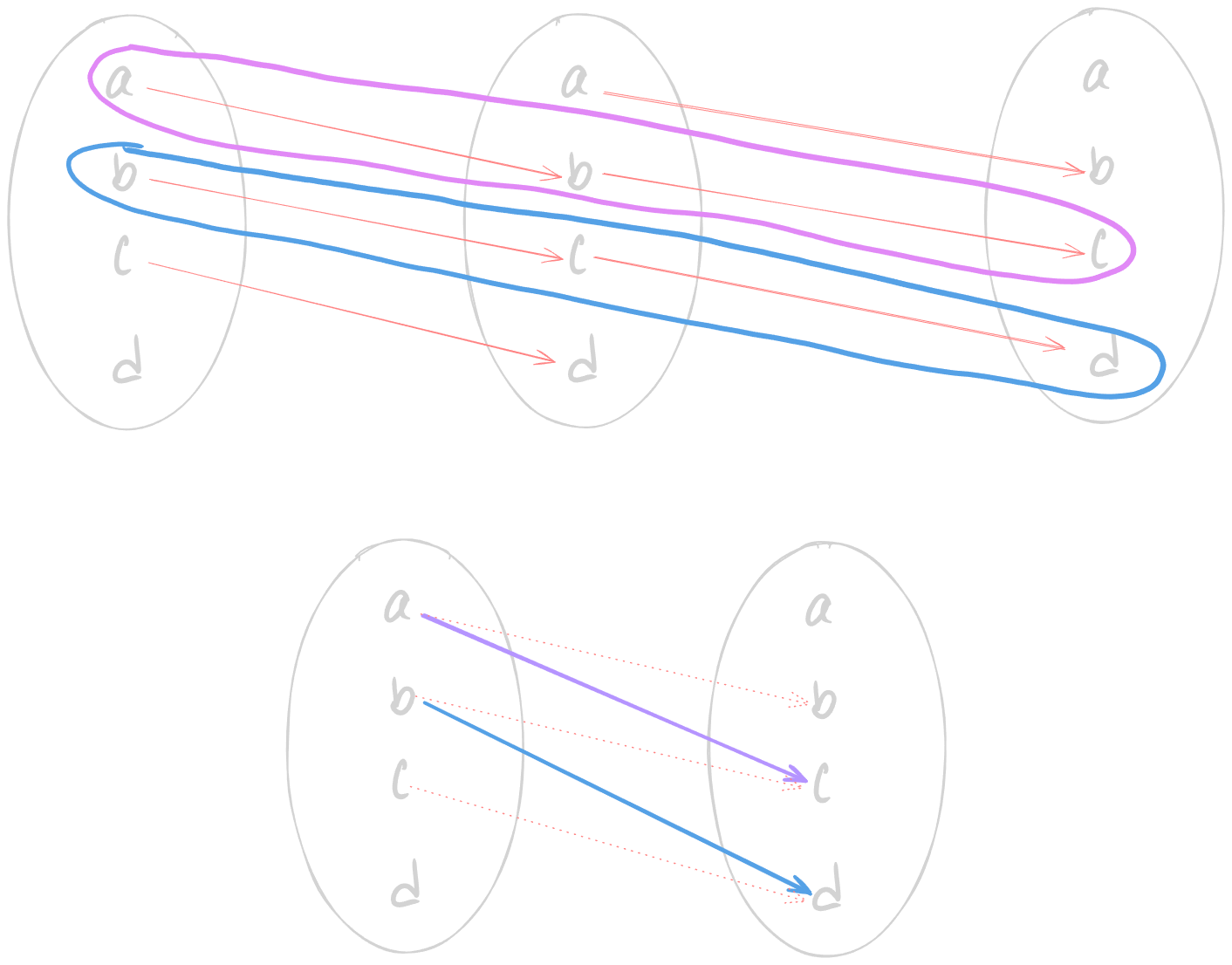
We can see that $R \circ R$ = {$(a, c), (b, d)$}.